
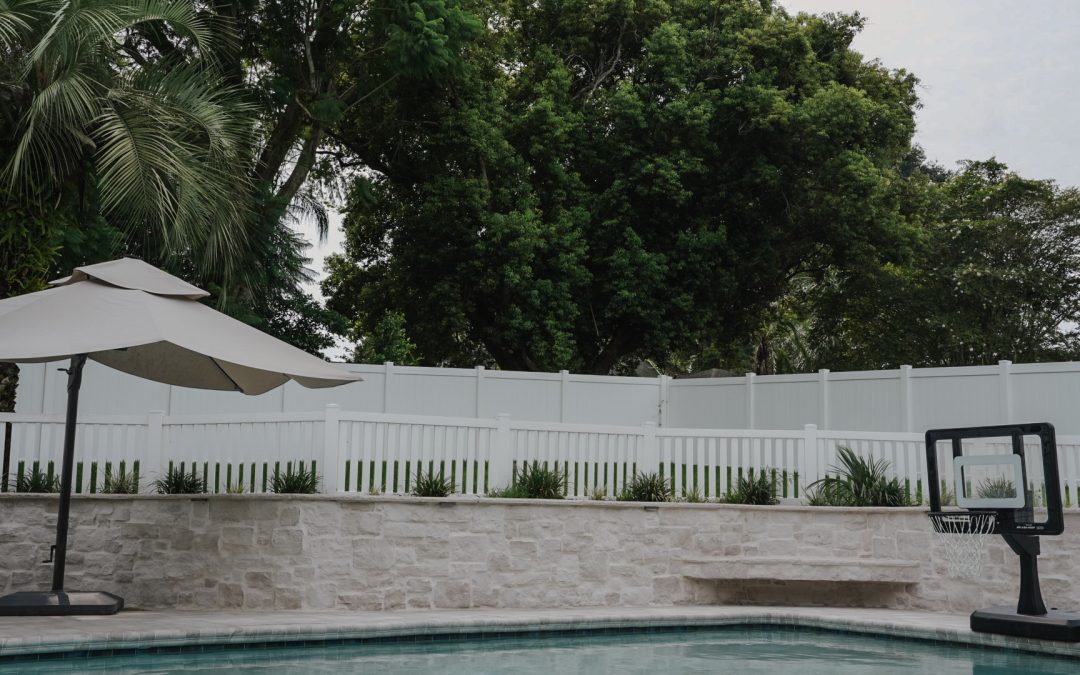
This post comes from Palm Masonry, based in Winter Park, Florida. Their crew works with both manufactured and natural stone across Central Florida, sourcing Horizon Stone product through their distributor, Stone Pro. Below, in their own words, is how they think about reading a stone wall before it ever goes up.
Table of Contents
- How a Mason Reads a Stone Wall
- A Little Mason Vocabulary
- We Don’t Lay Stone Straight Out of the Box
- The Two- or Three-Foot Joint
- Corners Are Where the Trick Gets Exposed
- Mortar Can Make or Break Great Stone
- Sometimes We Make a Perfect Cut Less Perfect
- Why We Like 19th Century Hermitage
- The Part You Can’t Really Google

How a Mason Reads a Stone Wall
There are things we look for in a stone installation almost immediately.
Can I follow a horizontal mortar joint for two or three feet? Are all the big stones hanging out together? Did someone stack two boxy pieces directly on top of each other? Are the corners actually interlocking, or can I see the pattern of the manufactured corner pieces marching up the wall?
Most homeowners aren’t going to walk up to a wall and identify any of those things by name. But they often feel them.
That’s because even when we’re installing manufactured stone veneer, which isn’t structural in the same way as traditional stone masonry, we’re trying to make it follow the visual logic of a real stone wall.
Look at old masonry in Italy, Portugal, the French countryside or throughout the Mediterranean. Those walls had to stand. Stones interlocked. Joints broke. Corners bonded together. Large and small pieces found their place based on what the wall needed.
We borrow heavily from that.
The goal isn’t to make manufactured stone pretend to be something it isn’t. It’s to give it the same kind of compositional logic that makes old masonry feel so natural.
And masons have developed some pretty good vocabulary for spotting when that logic breaks down.
A Little Mason Vocabulary
Spend enough time laying stone and you start giving names to the things you don’t want to see.
Boxcar: Two similarly boxy stones stacked on top of each other. One is fine. Stack them and suddenly your eye sees blocks instead of stone.
Tombstone: A stone standing taller than it is wide. Despite the name, tombstones aren’t forbidden. Real masonry has vertical stones. We just don’t want a cemetery of them marching across the wall.
Running joint: A horizontal mortar joint you can follow for too long. Once we’re tracing one for two or three feet, we’re looking for a way to break it.
Overgrout: A mortar finish where the joint comes forward and begins to “smile” onto the stone face. This is one of our favorites for old-world and Mediterranean-inspired work.
None of these is a manufacturer specification. They’re part of the language of the trade, and they help us talk about something that can otherwise be surprisingly difficult to explain: why one wall feels natural and another doesn’t.
We Don’t Lay Stone Straight Out of the Box
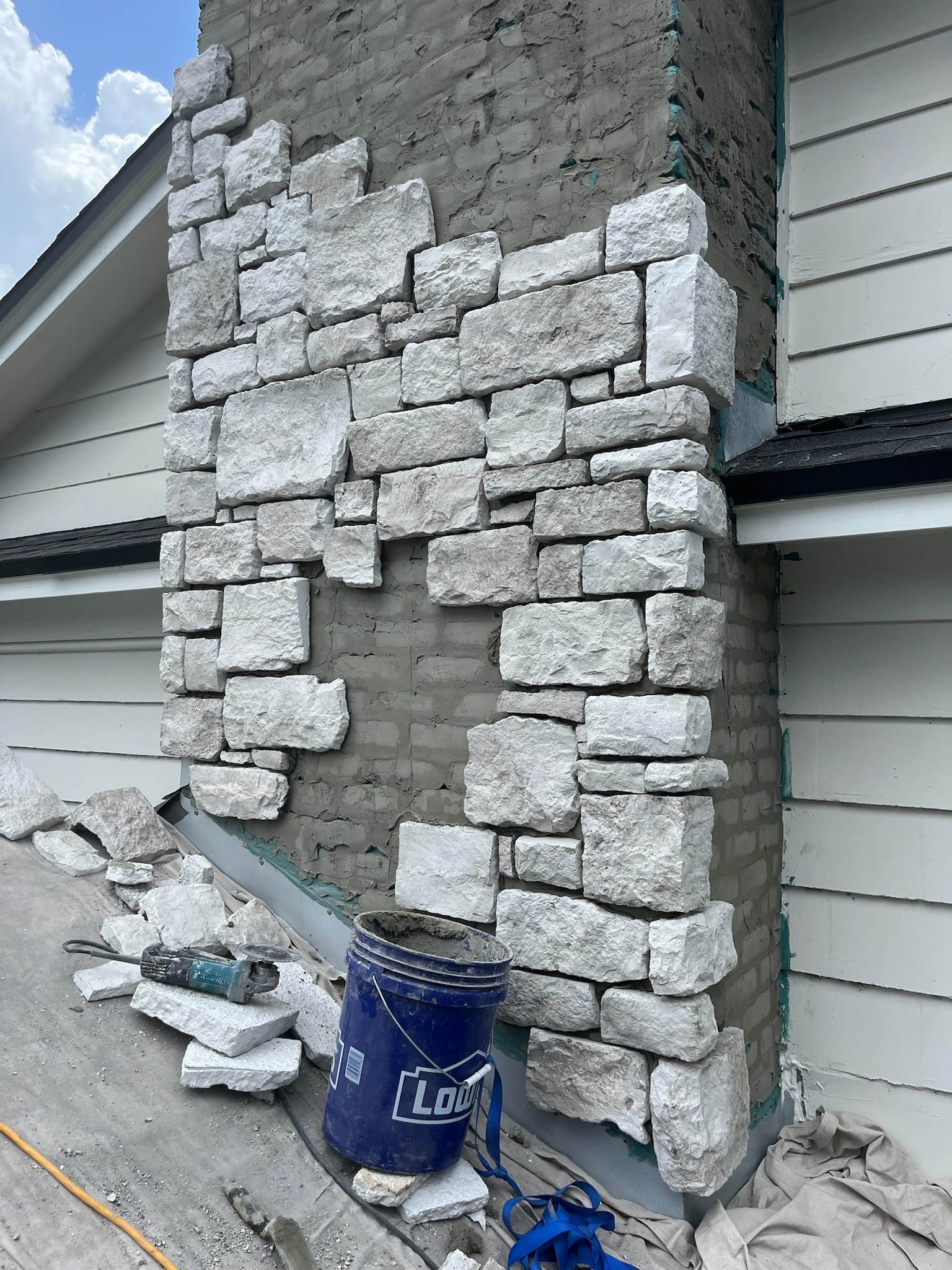
Before much material reaches the wall, we’re opening multiple boxes.
We’ll spread pieces across the ground or scaffold and start mentally organizing what we have: big pieces, small fillers, long stones, boxier stones, corners and color variations.
This is where a lot of manufactured stone installations go wrong.
If you work straight through one box or one pile, you can accidentally create little neighborhoods on the wall. The big stones all end up over here. The small ones collect over there. Three dark pieces land together. Then four long stones suddenly appear in the same section.
The product may have plenty of variation. The installer just failed to distribute it.
And not every stone has to make the team.
Sometimes a perfectly good piece stays out because we already have too many large stones in that area. Maybe its color is getting repetitive. Maybe its shape would create a boxcar. Maybe putting it there would extend a running joint another eighteen inches.
The Two- or Three-Foot Joint
This is probably the easiest thing we can teach someone to see.
Find a stone wall and follow the horizontal mortar joints with your eyes. If one continues through several stones for two or three feet, we’re usually going to break it.
In a true stone wall, pieces overlap and interlock, so long seams don’t create weak planes through the work. Manufactured veneer isn’t carrying that structural load, but your eye still recognizes the visual language.
So if the stone in my hand continues a long joint, I put it back down. Maybe I need a taller piece to change the elevation, a smaller stone to interrupt the line, or I need to move two other stones around. This happens constantly during installation.
There is no final step where we stand back and “fix the pattern.” By then, it’s too late. The pattern is being controlled one stone at a time.
Corners Are Where the Trick Gets Exposed
Corners are fun because when they’re done well, they almost disappear.
Manufactured corner pieces generally give us a longer return on one side and a shorter return on the other. If I put the long return this way on one course, I don’t want to mindlessly repeat that orientation all the way up the wall.
We alternate it: long, short, short, long, then maybe a bigger corner, then a narrower one.
At the same time, we’re checking the stones beside it. Did we just create a boxcar? Are two similar shapes stacked together? Are the joints at the corner suddenly wider than the joints across the rest of the wall?
What we’re recreating is the visual logic of a bonded masonry corner, where the corner stones tie both planes together in a real structural wall.
Get it right, and you stop seeing a collection of corner pieces. The wall just turns.
Mortar Can Make or Break Great Stone
We could probably write an entire article about mortar.
For much of our work, we’re living somewhere around one to two inches in joint width, but that number changes with the stone and the finish.
A few rules we tend to work by:
- More regular, boxy stone can handle tighter joints. Irregular stone often needs room to breathe.
- Recessed joints generally look better tighter. Overgrouted joints can open up more, since the mortar becomes part of the composition.
- Whatever language we choose, it stays consistent across the wall.
We especially love natural mortar colors like cream and alabaster.
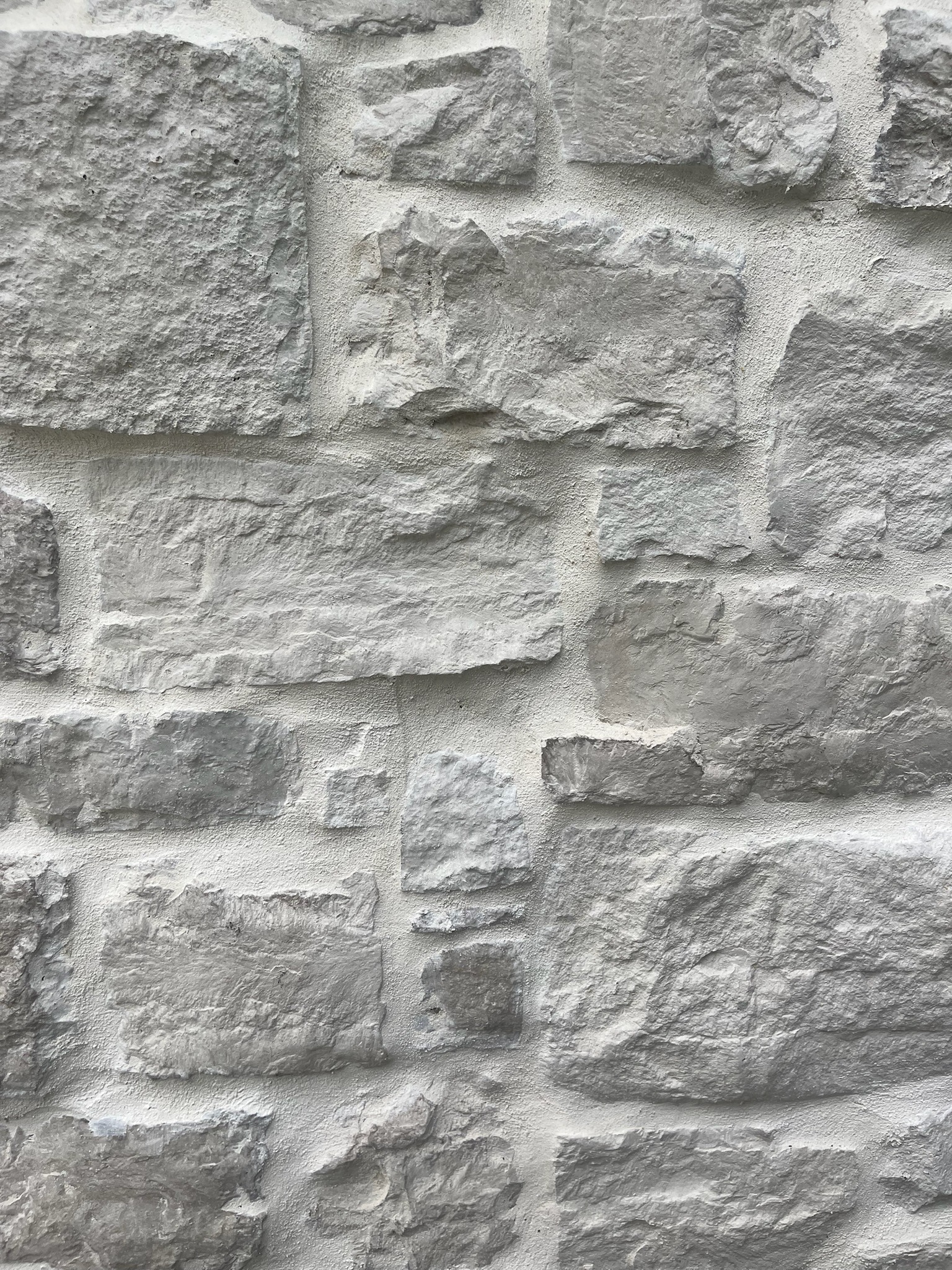
Pair one of those with a profile such as Horizon Stone’s 19th Century Hermitage, bring the mortar forward and let it smile onto portions of the stone face, and you start getting into the old-world Mediterranean territory we love.
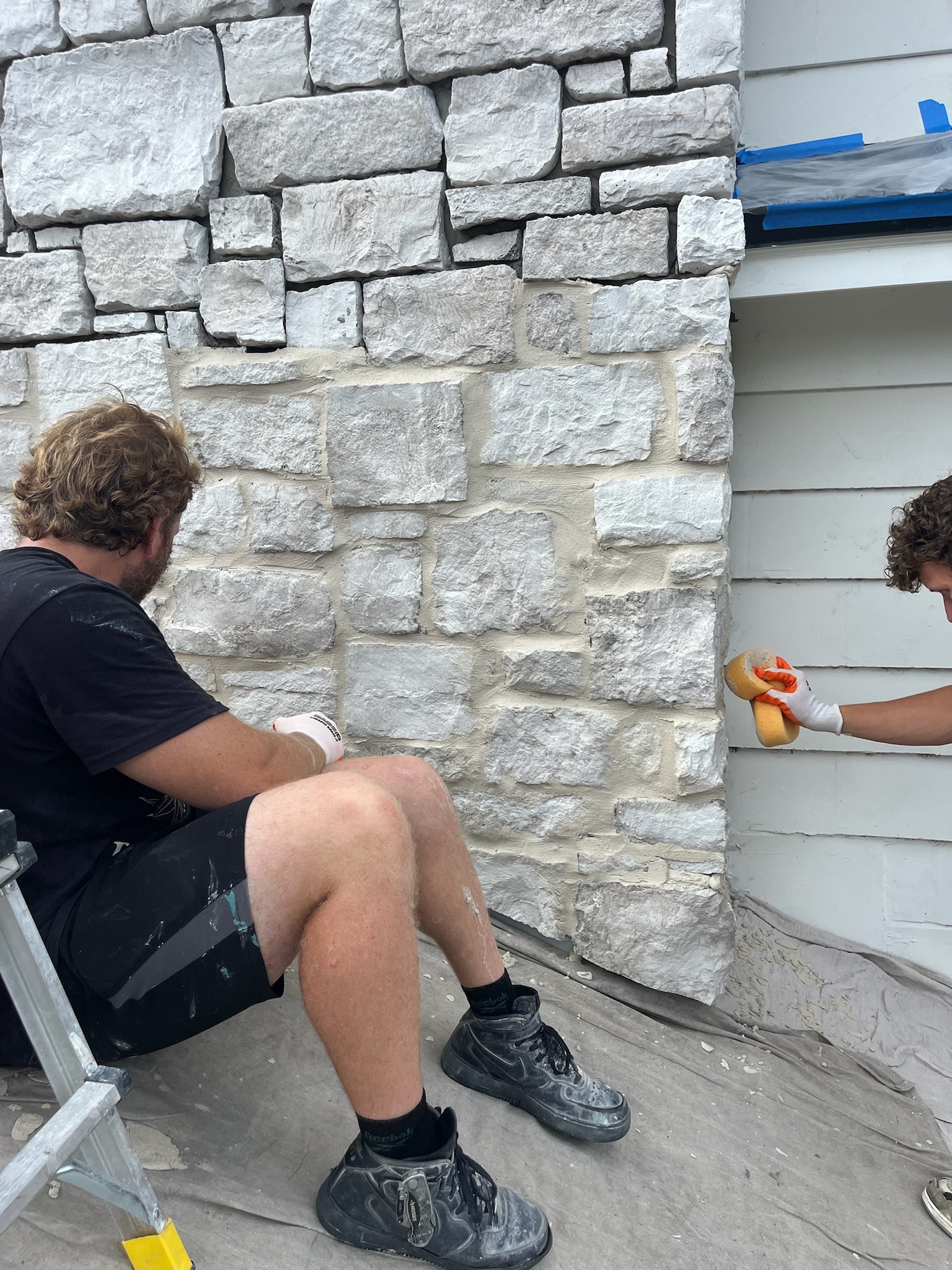
Then there’s timing. Brush a joint while it’s still too wet and the bristles leave lines, lines that dry right into the mortar and don’t go away.
Once you’ve learned to see brush lines, you start seeing them everywhere.
Sometimes We Make a Perfect Cut Less Perfect
This is another place where masonry can feel backwards.
We own saws capable of beautiful, perfectly straight cuts. Then sometimes we take a brick hammer to the cut.
That’s because the saw’s idea of perfect and the wall’s idea of perfect aren’t always the same. A bright, dead-straight edge can immediately expose how the stone was installed, so whenever possible, we cut from the back of the stone so the finished face breaks naturally. A skilled mason can then use a brick hammer to fracture that visible edge without destroying the piece, and the mortar does the rest of the work hiding the transition.
The result isn’t sloppy. It’s controlled imperfection. Real stone fractures, and we want the finished piece to retain some of that character.
Why We Like 19th Century Hermitage
We work with both manufactured and natural stone, which changes the way we judge manufactured products.
Our reference isn’t another manufactured-stone wall. We know what stone from a mountainside looks like.
That’s one reason we keep coming back to Horizon Stone’s 19th Century Hermitage. Horizon does a lot of the heavy lifting before we ever touch the material. Hermitage gives us enough variation in shape, size, texture and color to actually compose with it.
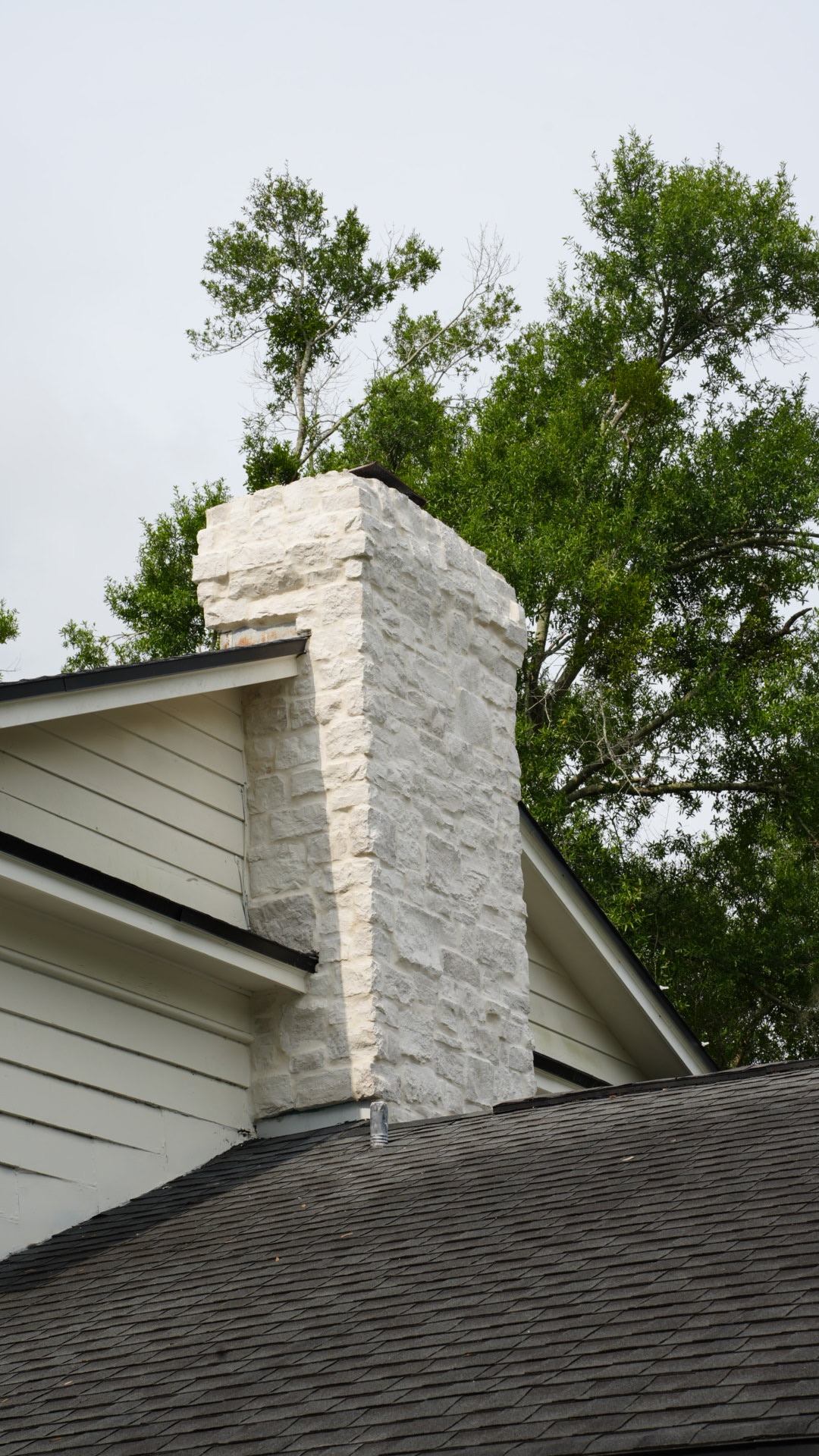
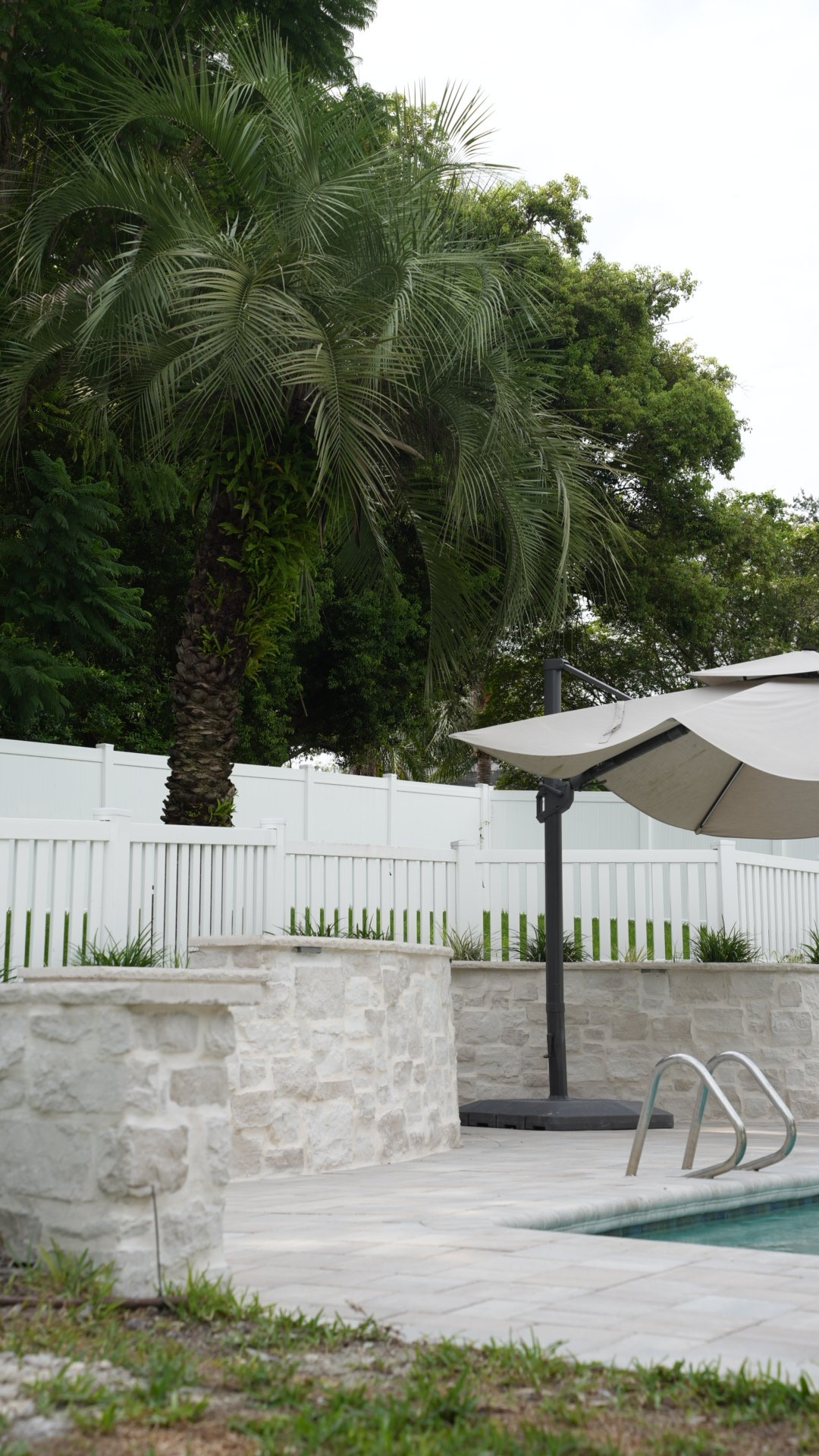
We recently used it on a home where the stone essentially took over the property. We revived the chimney, transformed the front elevation around the garage, and rebuilt the walls wrapping the pool area in 19th Century Hermitage with precast stone caps.
At that scale, you understand why we care so much about composition.
A sample can show you the texture and color of a stone. It can show how the face reacts to natural light.
It cannot show you:
- how the largest pieces will be dispersed across an elevation
- whether the colors are properly balanced
- how the corners will turn
- how one- to two-inch mortar joints will change the profile
- what an overgrouted cream mortar will do to the overall character
- how the stone will actually relate to the architecture
Renderings are becoming more valuable for that reason. Homeowners increasingly want to see the stone on their actual home before committing.
But even a great rendering can’t make all of the decisions that happen once the pallets are open.
The Part You Can’t Really Google
We live in an age where we assume almost all knowledge has been documented somewhere. If we don’t know something, we look it up.
Masonry is an ancient trade living inside that world, and some of its knowledge hasn’t made the transition.
Manufacturers can tell you about approved installation systems, substrates, and setting materials. But nobody’s written down exactly when a stone joint works, which stone should follow a long corner return, or how you know good mortar from bad by feel.
That knowledge still lives with masons, and there are only a handful of truly seasoned ones left in the Winter Park area to learn it from. You work beside them. You ask questions. You make mistakes. You study their work.
When the person isn’t there to ask, you study the masters another way; you look at old stonework in Italy, Portugal, the French countryside, walls that have already answered the question by standing for generations.
We have better tools now: better setting materials, better waterproofing, better manufactured stone. We can even show a homeowner a photorealistic rendering before the first pallet arrives.
But at some point, a mason still has to pick up a stone, look at the wall, and decide whether it belongs there.
Palm Masonry is based in Winter Park, Florida, and sources Horizon Stone products through distributor Stone Pro. See more of their work at palmmasonry.com.
Ready to see 19th Century Hermitage on your own home?
Horizon Stone sells exclusively through a nationwide dealer network. Find an installer near you.