
Straight from our installation guides: the moisture control, bonding, and cold-weather
details that keep a Horizon Stone installation looking right for the long run, plus answers
to the questions we hear most from masons and dealers.
or the Complete Installation Guide.
For piece dimensions and coverage, see our Technical Data Sheets.

Moisture Control
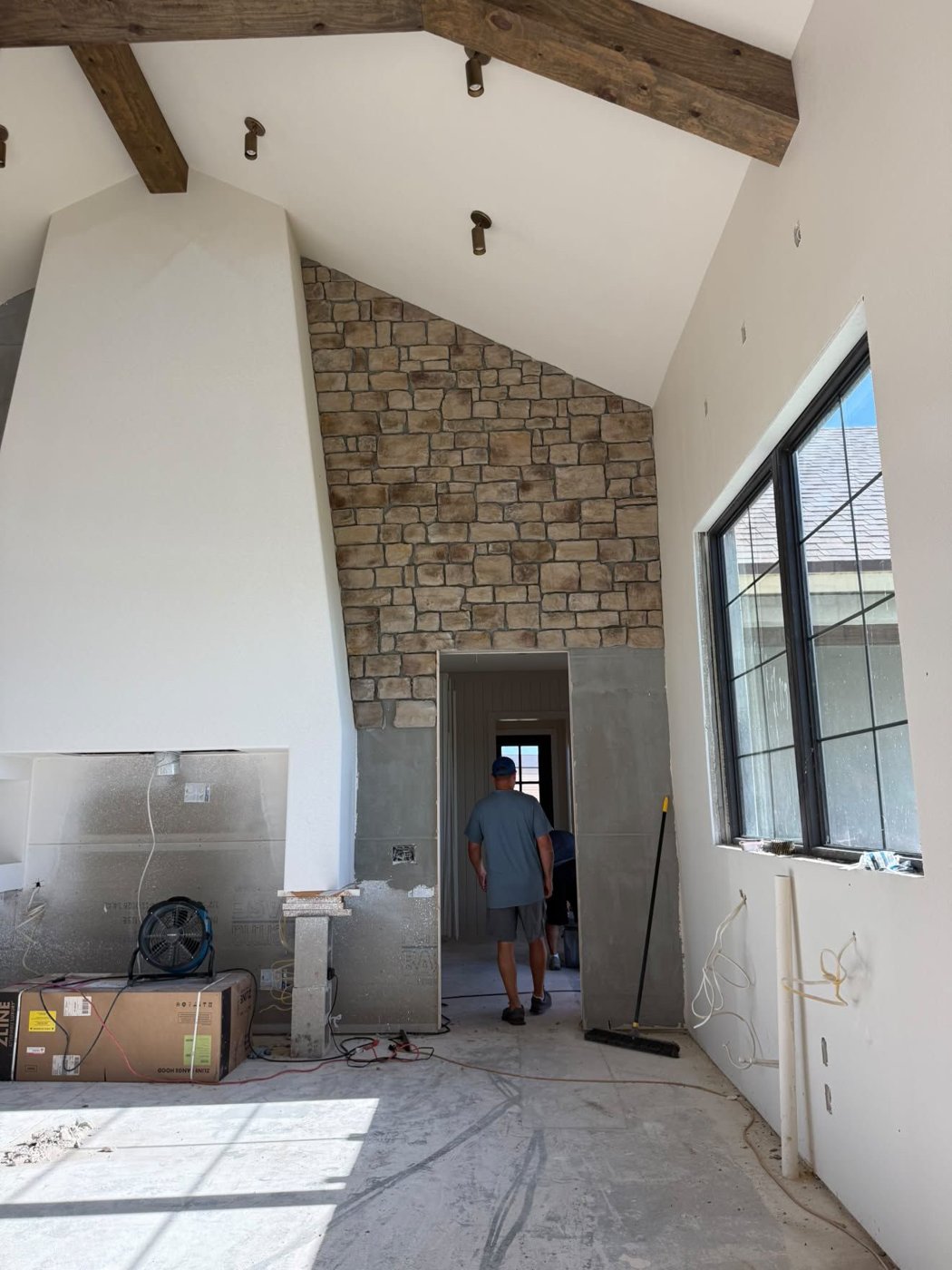
Scratch coat and framing visible during an active install, before the stone is fully set.
- There should be two layers of weather-resistive barrier (WRB) behind the lath and scratch coat to restrict moisture reaching the surface behind it.
- Acceptable WRB combinations: two layers of felt, two layers of Grade D paper, or one layer of house wrap used with either felt or paper.
- The scratch coat should completely cover the lath, leaving no voids.
- Flashing should be installed before the adhered stone units on all doors and windows.
- All flashing and flashing accessories must be corrosion-resistant and integrated with the stone materials.
- Flashing must be installed at all through-wall penetrations and at the termination of stone installations.
Rainscreen drainage plane systems (optional)
A long-used construction technique to improve the escape of incidental water and decrease drying time.
Rainscreen products (drainage mats, formed polymer sheeting) or techniques (strapping, furring) that
create a capillary break or air space between the cladding and the primary WRB can be effectively
incorporated into Horizon Stone applications.
Flashing, weep screeds, casing bead & movement joints
- All flashing and metal detail pieces should be corrosion-resistant.
- Verify all flashing, including roofing kickout flashing, is properly installed. Roof flashings aren't part of the wall cladding system, but they're necessary for proper moisture management.
- Flashing material should extend above horizontal terminations, roofing material, and drainage planes or products.
- All flashing material should be integrated with the WRB to prevent moisture penetration into the structure. The WRB should overlap the weep screed flange.
Preventing Cracking
- Metal lath and WRB need to wrap continuously around all outside and inside corners a minimum of 16 inches, and attach every 6 inches at the next stud. WRB should lap WRB, and lath should lap lath.
- On flat wall areas, metal lath needs to overlap 1 inch horizontally and vertically. WRB should overlap 2 inches horizontally and 6 inches vertically.
- Mortar mixed with higher cement content may be prone to cracking.
Bond
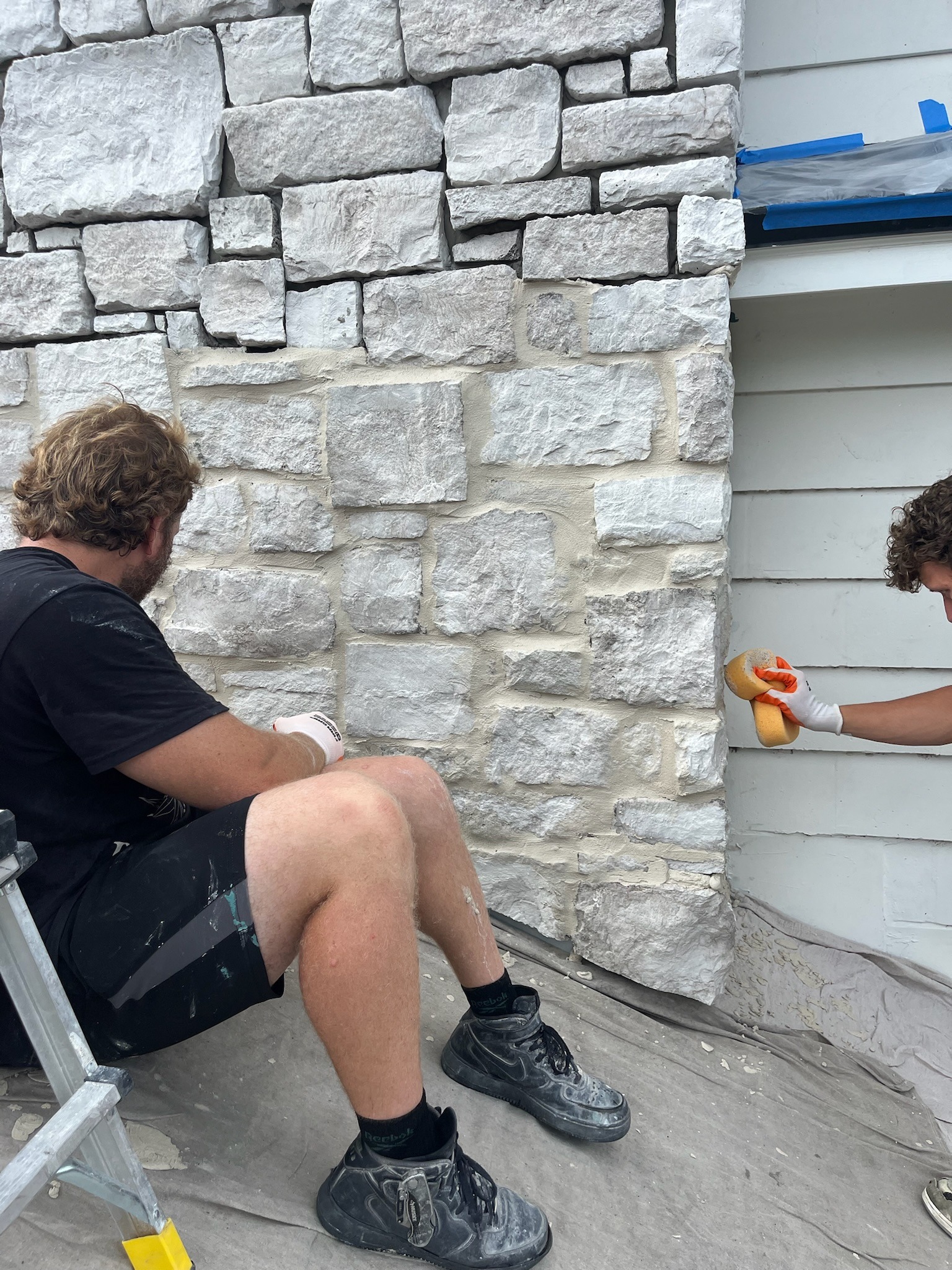
19th Century Hermitage installed by Palm Masonry.
- Moisten the back of the stone, and the scratch coat, so both surfaces appear damp, without standing water. This matters most in hot conditions.
- Moist-cure the mortar scratch coat before applying stone, this helps minimize cracking and ensures proper hydration.
- Butter the entire back of the stone, not just the perimeter, with an even, nominal thickness.
- Firmly work each piece, especially large ones, onto the scratch coat and slide it slightly back and forth with a slight rotating motion to set it. You should feel the stone grab within a few seconds.
- Once the stone has set, don't move it again, the bond will break. If it's moved after the initial set, remove it, scrape the mortar off the back of the stone and the scratch coat, and reattach properly.
- Grout the joints only after the installation has had sufficient cure time, once mild contact won't break the bond.
Cold Weather
Cleaning
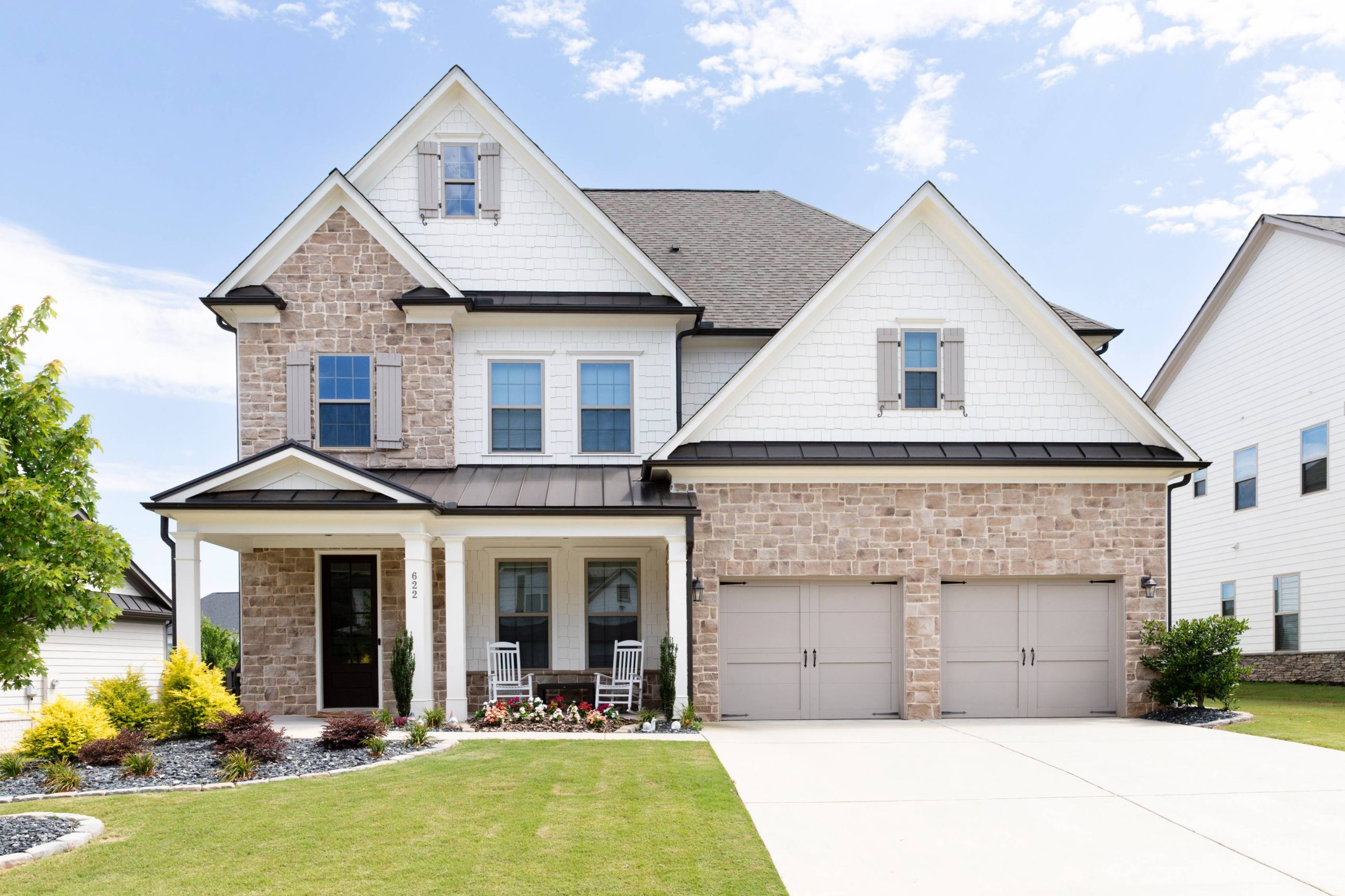
Instead, use a soft brush, soap, water, and a low-pressure hose.
Common Questions
Is the quantity on the box figured with a mortar joint?
All Horizon Stone boxes contain the actual square footage as stated on the box, except for 19th Century, which is figured with a mortar joint.
How much mortar is needed for a job?
It varies by mason, but typically: drystacked installations use 3–4 bags per 100 square feet, and mortar-joint installations use 4–5 bags per 100 square feet.
Can you use hearthstones for steps?
It's not recommended to use hearthstones for steps or to drive on.
call our office at 423.629.0801, or reach out to your sales representative.